
The Hidden Challenges Behind “Pouring in Place” Epoxy Countertops
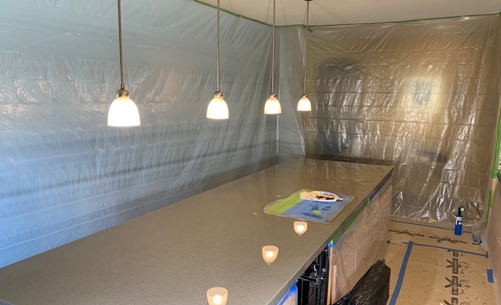
If you’ve spent any time online researching epoxy countertops, you’ve probably come across videos showing epoxy being poured directly over existing surfaces like tile, laminate, or old countertops. It’s often called “pouring in place,” and on the surface it can look fast, affordable, and surprisingly easy.
We get the appeal—because we tried it ourselves years ago, before we officially launched Artisan Design Concepts. But once we became a professional countertop company, we made a firm decision: we do not pour epoxy over existing countertops when at all possible. Instead, we build brand-new epoxy countertops for every project.
Here’s why we made that choice—and how it ultimately benefits our customers.
The Reality of Prep Work
Pouring epoxy in place isn’t as simple as it looks online. In fact, most of the cost and labor is in the prep, not the pour.
Depending on the existing surface, prep can include:
- Filling grout lines on tile countertops with a concrete-like filler
- Aggressively sanding slick or glossy surfaces so epoxy can adhere
- Routing edges so epoxy can flow over them properly
- Removing backsplashes, since epoxy cannot be poured vertically
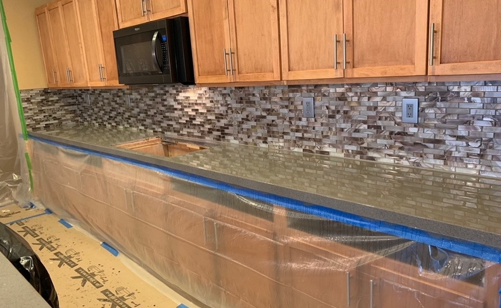
- Protecting floors, cabinets, and walls with layers of plastic, tape, and Ram Board
All of this must be done perfectly. One missed seam, one weak tape line, or one uneven area can cause major issues later. Prep alone can take an entire day—or more—when done correctly.
Risk of Damage and Environmental Challenges
Even with professional-grade tape and plastic, epoxy can still find a way to drip. Cabinets, flooring, and appliances are all at risk. We know this firsthand—our own cabinets paid the price during early experiments.
There are also real-world factors you can’t control in an occupied home:
- Airflow from HVAC systems
- Temperature fluctuations
- Pets, children, and well-meaning adults who “just want to touch it”
- Cabinets and floors that are not perfectly level
Epoxy is self-leveling. If your cabinets aren’t level (and most aren’t), epoxy will flow unevenly, which can distort the design and thickness of the surface.
The Time Commitment No One Talks About
Pouring in place is not a one-day process. It’s a multi-day, labor-intensive operation that completely takes over the home.
A typical pour-in-place timeline looks like this:
Day 1:
- Protect cabinets, walls, and floors
- Prep existing countertops
- Apply bonding primer (requires 24 hours to off-gas)
Day 2:
- Apply color coat, often involving strong odors or spray products
- Manage drips for 3–4 hours
- Carefully remove tape and plastic before epoxy locks it in permanently
Day 3:
- Re-mask the space
- Sand the epoxy surface (creating epoxy dust inside the home)
- Pour clear coat and repeat drip management
Day 4:
- Sand again
- Apply the final rolled topcoat
- No touching for at least 24 hours
- No use for 2 additional days while it cures
Day 7:
- Return for final detailing
- Install sinks, faucets, and stoves
- Install backsplashes if poured separately
Only after all of that does the homeowner finally get their kitchen back.
Why We Build New Countertops Instead
Building brand-new epoxy countertops allows us to eliminate most of those risks and inconveniences.
Here’s how the process is different:
- We template your counters in your home for a precise fit
- All epoxy work is done in our shop, not your kitchen
- No fumes, dust, or sticky mess inside your home
- Epoxy is poured on a level surface in a controlled environment
- We can work on multiple projects efficiently without rushing yours
When we return for installation—typically about two weeks later—your countertops are ready to use the moment we leave.
A Clear Cost Comparison
Let’s look at labor alone.
New build countertops (average kitchen):
- 12-16 hours to build
- 6 hours to pour
- 6 hours to install
Total: ~24-28 labor hours
Pouring in place:
- Days 1–4: ~8 hours per day (32 hours)
- Day 7: 2–3 hours for final touches and installations
- Even more if backsplashes are poured separately
- Plus time for final clean up of surrounding areas
That’s 10+ additional labor hours, not including travel time to and from the home, far exceeding the cost of materials required to build brand-new countertops from scratch.
The Bottom Line
Pouring epoxy over existing countertops may look simple online, but in real life it’s:
- More labor-intensive
- Riskier for your home
- More disruptive to your daily life
- More expensive in the long run
By building new epoxy countertops, we deliver a higher-quality result, minimize disruption, and keep costs lower—while still coming in below the price of high-end stone surfaces.
That’s why we do it the way we do.
